Old School, Not Old Fashioned
Some people call Dr. Pol “old school.” He says it’s a good thing. Whether it’s a roll-and-stitch procedure or injectable anesthesia, Dr. Pol uses the best tools for the job, because he is committed to providing the best care for both animals and their owners, even if he has to learn something new along the way.
Grab a cup of coffee, pull up a chair, and let’s talk animals.
Every now and then I hear someone describe me as an “old-school veterinarian.”
They’re right.
At least… partly.
The funny thing is that some people use “old school” like it’s an insult.
I don’t.
To me, old school simply means using the method that works best for the animal and the owner, not the newest method just because it’s new.
After more than fifty years of practicing veterinary medicine, I’ve learned something very important.
New doesn’t automatically mean better.
Old doesn’t automatically mean outdated.
And good medicine is about knowing the difference.
When I was in veterinary school, a farmer brought a sick cow into our teaching hospital.
The school had just gotten a brand-new X-ray machine. Everyone was excited about it. Our professors told us this technology was going to revolutionize large animal veterinary medicine. It could even take an X-ray through a cow. We thought it was incredible.
So we examined the cow.
She had a fever. Her stomach wasn’t working. She was in pain.
Everything pointed to hardware, meaning we believed the cow had swallowed a piece of metal. This is very common; cows are indiscriminate eaters. They will sometimes even eat pieces of metal.
So we sent her to the X-ray department. The X-ray came back negative. No metal showed on the X-ray.
We examined her again.
Everything still pointed to hardware.
Another X-ray.
Negative.
A few days later, that cow died. At school they taught us that whenever an animal dies, especially if you don’t know why, you perform an autopsy. And they found that cow had hardware.
Except that it wasn’t metal. It was a broom bristle six inches long. That cow had swallowed it and the bristle punctured the stomach wall, went into her heart, and it killed her. If we had listened to what that cow was telling us, we would have done surgery. Based on her condition when she arrived, we believed surgery could have saved her.
That cow taught me one of the most important lessons of my career. Machines are wonderful tools. But they should never replace your hands, your eyes, your ears, or your judgment.
I learned to be a hands-on vet. An “old-school” vet.
My goal isn’t to use the oldest technique. My goal is to use the best one.
When I first got out of school, we used to do a complicated surgery for DAs (Displaced Abomasums). When I started my practice, the farmers around here didn’t like that complicated surgery. Not because they didn’t care about their cows. Because many of them simply couldn’t afford it.
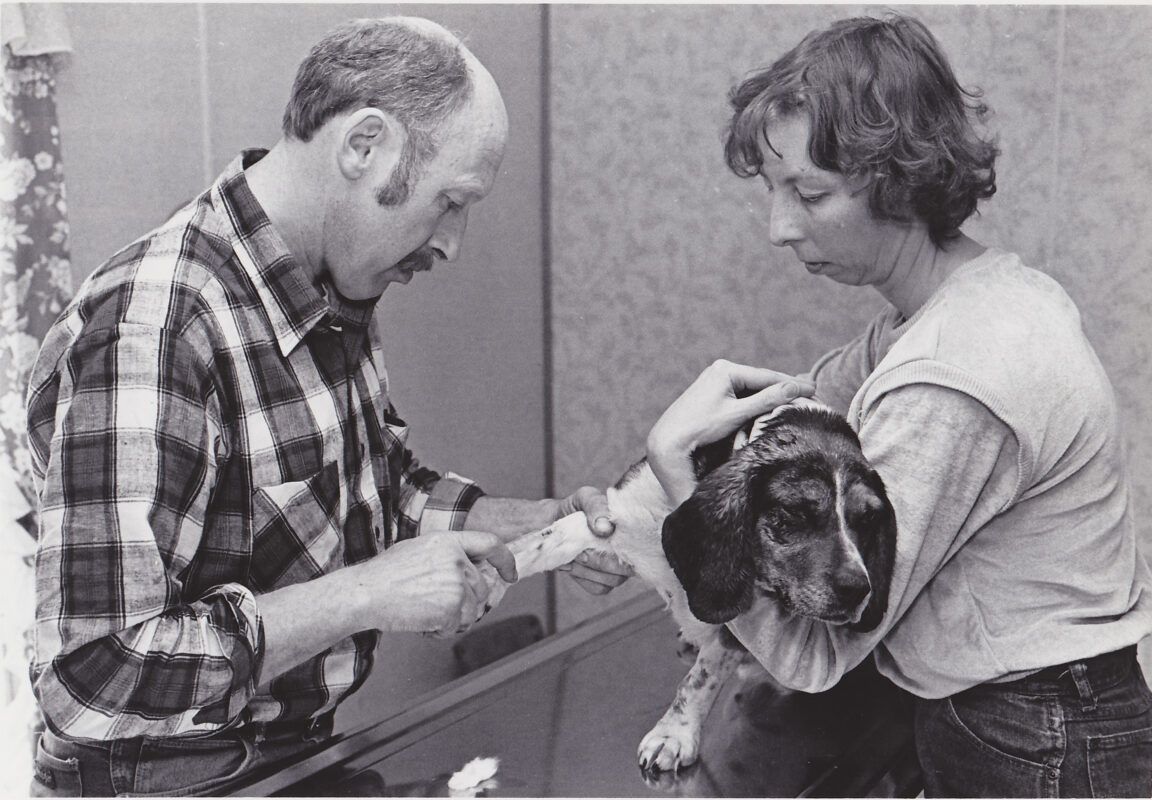
So, I started to use an older method, the roll-and-stitch procedure. It’s simple. You know what? That old-school procedure got the job done safely, quickly, and at a much lower cost for the owner. If you’ve watched the show, you’ve seen me perform that procedure a lot.
Good medicine isn’t about doing the most complicated procedure. It’s about doing the right procedure for the case.
Now here’s the part people don’t always expect.
I haven’t spent fifty years refusing to change. I’ve spent fifty years learning.
Some of the best things I’ve ever learned came from the younger veterinarians who joined my practice.
One associate had worked as an anesthesiologist before becoming a veterinarian. He taught me a tremendous amount about injectable anesthesia. For the procedures we perform, I believe it’s an excellent option.
For the protocols we use, some of the drugs can be reversed. These protocols often require fewer people to administer and monitor. They can reduce stress in certain patients. And because they often require less equipment and personnel, they can reduce the cost for the client.
That’s not being stubborn. That’s simply using a more efficient tool for the job.
The same is true throughout our clinic.
Over the years we’ve invested in digital X-ray systems, ultrasound machines, modern laboratory analyzers, laser therapy, and countless other advances.
Why?
Because they help us diagnose animals faster. They help us treat animals better. And when they truly improve care, they’re worth every penny.
People sometimes think I don’t like new technology.
Nothing could be further from the truth.
I love learning. I still enjoy going to veterinary conferences every year. Yes, I have to earn continuing education credits.
I go because I’m always hoping to come home having learned something new that will help me take better care of my patients. Sometimes it’s a better way to think about an old problem. Sometimes it’s a new medication. Sometimes it’s a brand-new technique.
But if a technique that’s been around for fifty years or a hundred still gives the best outcome… Why would I stop using it?
I don’t believe in old medicine or new medicine.
I believe in good medicine.
Sometimes good medicine looks brand new.
Sometimes it looks like a Thomas splint for a dog, or a bushel basket for a calf. Bushel baskets are made from flexible but strong material. By setting the calf’s leg with pieces of the basket, the splint provides strong support. At the same time, the splint allows the calf to continue to grow because it’s flexible horizontally but not vertically. I’ve saved hundreds of dogs and calves with those simple tools because, in the right situation, they still work. And I’m perfectly happy with that.
My clients have always been hardworking people. Farmers. Families. People who love their animals but still have bills to pay. Whenever appropriate, I offer my clients several treatment options and explain what each will cost. I’ve never believed the best medicine is the one with the biggest price tag. The best medicine is the one that makes the animal healthy again.
We’ll see ya.
– Dr. Jan Pol